A powerful combination of tornadoes, destructive winds and baseball-sized hail has caused widespread destruction across parts of the Midwest, leaving farmers with damaged crops, financial uncertainty and renewed concerns about the changing pattern of severe weather.
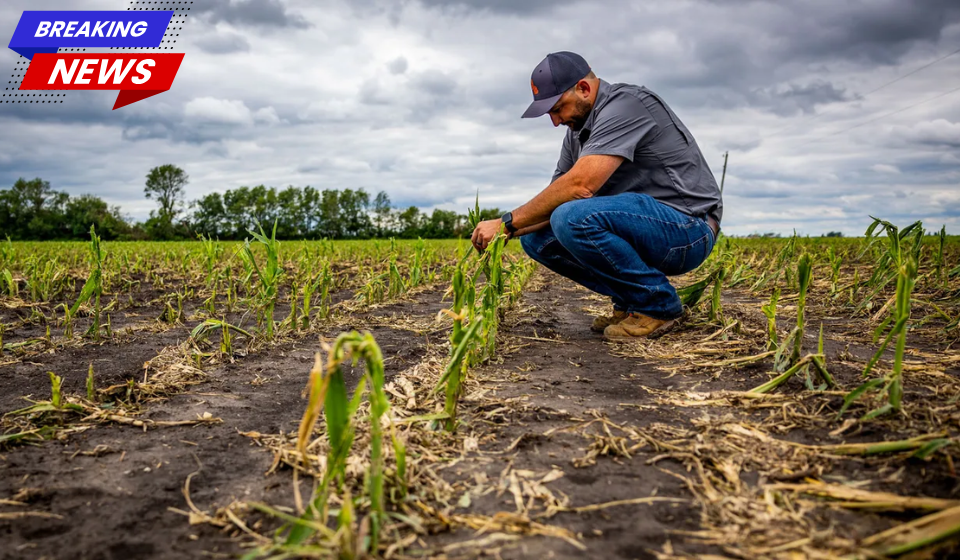
For Alex and Lena Head, farmers in Harristown, Illinois, the June 17 storm became a disaster they will not soon forget. The family lost hundreds of acres of crops after a violent storm system tore through Macon County, destroying corn fields and severely damaging soybean crops.
The event has become an example of how extreme weather is increasingly affecting areas farther east, with experts saying Illinois and other Midwestern states are seeing more frequent high-impact storms that were once more common in traditional Tornado Alley regions.
A Storm That Changed Everything for One Illinois Farm Family
Alex Head was standing outside his home when he noticed the sky beginning to darken. Weather forecasts had warned of a dangerous multistate storm system, and the warning maps showed the most severe conditions moving directly toward Macon County.
His wife, Lena, and their 2-month-old son, Callahan, had already moved into the basement for safety.
Soon after, a funnel cloud appeared, forcing Alex to rush inside and join his family as the storm moved through the area.
After the storm passed, Alex received a phone call from a neighbor asking for help. The neighbor reported baseball-sized hail, damage to the house and fallen trees.
The neighbor also suggested that the Heads check their nearby fields while traveling over to help.
When Alex, Lena and their family drove toward the property, they saw something devastating.
Their corn fields had been shredded down to the stalks. Areas where soybean plants had been growing were reduced to damaged stems.
The destruction continued as far as they could see.
“I’ve never seen anything like it,” Alex Head said. “It just got worse and worse the farther we went. Devastation as far as our eyes could see.”
Historic Severe Weather Hits Illinois and Indiana
The June 17 storm system brought some of the most damaging weather conditions seen in parts of Illinois and Indiana this year.
Meteorologists described the day as “historically volatile,” with tornadoes, winds reaching nearly 100 mph and large hail causing widespread agricultural damage.
The Head family’s farm was among many operations caught directly in the storm’s path.
According to Eric Snodgrass, senior science fellow at Nutrien Ag Solutions, severe weather patterns are shifting, putting Illinois increasingly at risk.
“Spring and summer severe weather events have moved farther east over time, which puts Illinois squarely in the middle of the worst,” Snodgrass said.
Research published in peer-reviewed scientific studies has suggested that the traditional Tornado Alley region has shifted over the past several decades from the Great Plains toward the Midwest.
Snodgrass explained that the Mississippi Valley now has more frequent combinations of moisture, instability and atmospheric conditions needed for tornadoes, damaging winds and severe hail.
Illinois Sees Record Number of Tornado Reports
The 2026 storm season has highlighted the changing weather pattern.
The National Weather Service reported 180 tornado sightings in Illinois during the year so far, a number that is nearly double the combined total reported in Oklahoma and Texas.
Experts say several weather factors contributed to the unusually active storm season.
A spring drought in the Plains, a high-pressure system near the East Coast, moisture flowing north from the Gulf of Mexico and an active jet stream created an atmosphere capable of producing severe storms.
“Long story short, it kind of focused all of that instability and moisture right over Illinois,” Snodgrass explained.
Climate Trends Create New Challenges for Farmers
Matt Montgomery, an agronomy education leader with Beck’s, said farmers have noticed major changes in growing conditions during recent decades.
He said the Midwest has experienced more summer heat and increased spring moisture compared with previous generations.
The region has gained the equivalent of seven to 12 additional summer days over the last 30 years, creating both opportunities and challenges.
A longer growing season can improve crop yields, but extreme weather events can erase those benefits quickly.
Montgomery said crop damage depends on three major factors:
- The type of weather event
- The growth stage of the crops
- The crop variety being planted
Wind damage can sometimes be overcome if crops recover quickly. However, hail and tornadoes often cause permanent damage by destroying plants and damaging their growing points.
Crop Variety and Preparation Can Reduce Risk
Farm experts say farmers can reduce some risks by avoiding dependence on a single crop variety.
Montgomery advised growers to plant multiple varieties because different crops respond differently to weather events.
“The takeaway is that we must diversify our crop package to spread out risk,” he said.
He explained that planting several varieties can prevent an entire operation from being destroyed by one storm because not every field will be equally vulnerable at the same time.
Insurance Becomes Critical After Massive Crop Losses
For many farmers affected by the storm, crop insurance has become the difference between survival and financial collapse.
Montgomery said multi-peril crop insurance is now an essential part of modern farming because severe weather risks have increased.
“Significant hiccups to grower income can undoubtedly shut down an operation because of the expenditures required to produce a crop,” he said.
Dylan Houser, crop claims manager for Country Financial, said farmers should review their insurance coverage before disasters happen.
“Catastrophic events like this may be once in a lifetime, but having adequate crop insurance coverage in place helps ensure that a farming operation can recover from a major weather event and continue farming for years to come,” Houser said.
By July 10, Country Financial had already received 76% of its five-year crop hail insurance claim totals.
Houser said the hail damage in parts of Macon County ranked among the most severe the company had seen in years.
“This was truly catastrophic damage,” he said. “For some farms, it could result in a total crop loss.”
Head Family Faces Hundreds of Acres of Damage
After insurance inspections, the Head family learned the full extent of their losses.
Their adjuster determined:
- 200 acres of corn were a complete loss
- 200 acres of soybeans suffered about 70% damage
- Another 160 acres of soybeans suffered about 30% damage
Despite the destruction, the family was able to begin recovering because of their insurance coverage.
“Luckily we had crop insurance,” Alex Head said. “Otherwise, this year would be a different ballgame for our family farm.”
At the end of June, the family replanted early-maturing corn and soybeans in damaged fields.
The goal was not necessarily to recover all losses but to produce enough yield to cover expenses.
“We just take enough insurance to cover our expenses,” Head explained. “Essentially, we’re replanting in an effort to land above a breakeven.”
Farmers Continue Forward Despite Uncertainty
The Head family also operates a cattle business. If their damaged corn does not produce enough grain before frost arrives, they plan to use the crop as cattle feed.
Head said farming has always involved uncertainty, whether from weather, markets or production challenges.
“We’re already gamblers every day as farmers — with yield, with markets and with weather,” he said. “Insurance is just one way to make our risky profession slightly less risky.”
Experts Urge Farmers to Prepare for Future Storms
Illinois State Climatologist Trent Ford said farmers should begin preparing now for future severe weather events.
“We don’t know that years like this are possible until they happen,” Ford said.
He noted that the damage in 2026 was not limited to isolated farms but affected many communities across the region.
Ford said preparation should focus on two major areas: communication and infrastructure.
As severe storms become more common across the Midwest, farmers, scientists and officials say planning, diversification and financial protection will play an increasingly important role in helping agricultural communities survive future weather disasters.